Shipped & live
End-to-end Product Designer
Nobody panic. Your gate is...
somewhere that way.
Connecting flights are one of those experiences that can go brilliantly or catastrophically often depending on information that should be trivially easy to provide. I spent some time figuring out why we weren't providing it, what it would actually take to fix, and what I got wrong along the way.
Service designer, Business Owner, Product team, Product Designer (🙋)
End to end Product Designer
No real-time maps, budget & API limits
2023 - Now (Continuous improvement)
Before — 2024
Average transfer experience rating same survey instrument used throughout.
After — April 2025
Post-launch rating across 2,000+ passengers
of passengers found transferring at AMS genuinely challenging
shortest connection sold through a major hub airport
missed connections: biggest single driver of NPS drops in our data

01.
Problem

Passengers were navigating blind through some of Europe's busiest airports
Imagine landing with 70 minutes until your next flight and no idea where the gate is, how long security takes, or whether you are cutting it close.
That was the default experience for connecting passengers.
When we looked into why, the same four problems kept coming up:
people did not know what steps to take,
had no reassurance that they would make their flight,
could not gauge how long the transfer actually took,
and got almost no help from the airline's app or website at the one moment they needed it.
Where I got it wrong first
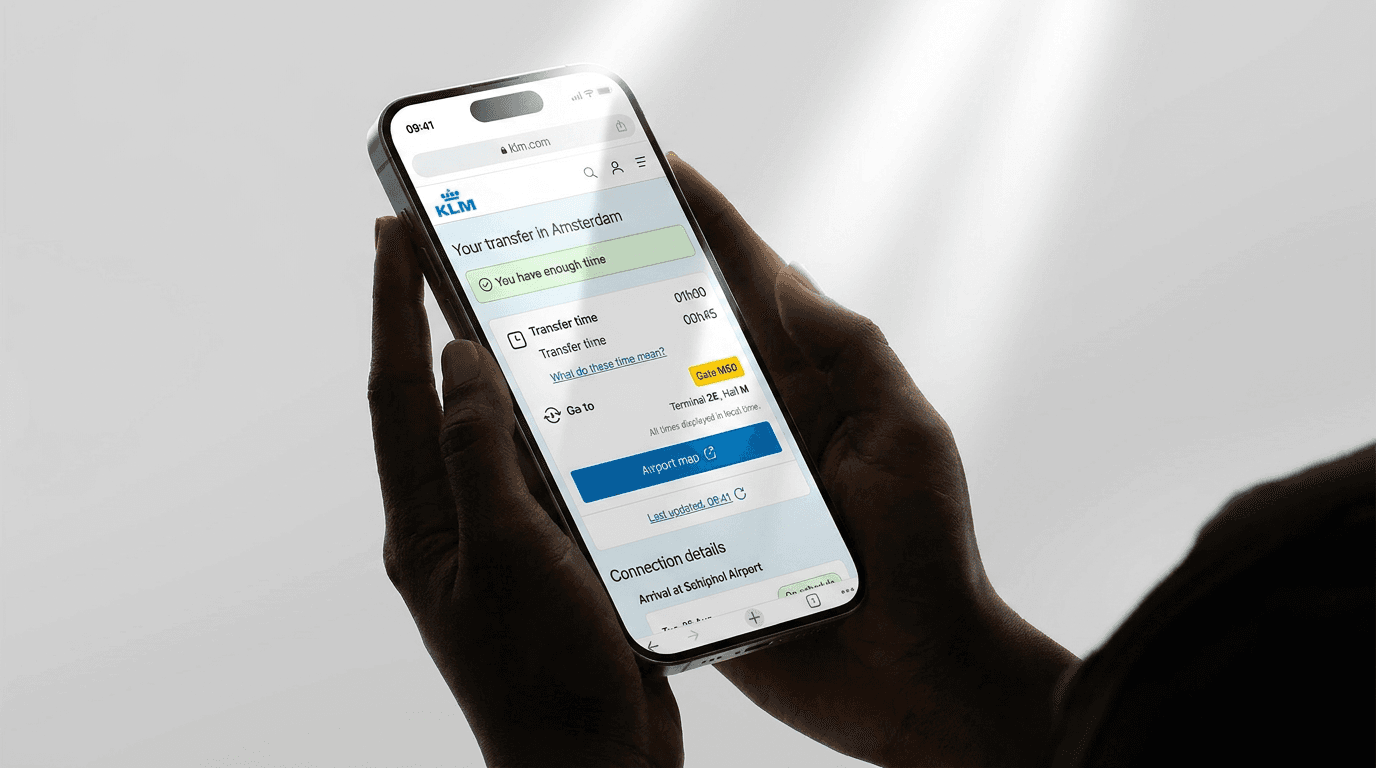
I came in assuming this was a wayfinding problem, better maps and clearer directions. We even scoped real-time map integration early on, before budget and technical limits ruled it out. That constraint turned out to be useful, because it forced a better question. The real issue was anxiety caused by uncertainty, not distance. Passengers did not need a map. They needed three facts at the right moment.
02.
Research
Each round of research made the next design less wrong
I led the product design alongside a UX researcher and a service designer.
Our richest evidence came from a diary study, where 18 travellers documented their connections in real time as they moved through Amsterdam and Paris, capturing the experience as it actually happened rather than how they recalled it later.
Around that, we ran early concept tests, interviews focused specifically on missed connections, and several rounds of usability testing on interactive prototypes.
Our core findings came from frequent flyers, people who knew the journey well and could pinpoint exactly where it broke down.
The final, sharper details emerged when we tested with infrequent flyers, who surfaced friction the regulars had simply learned to work around.
Together, the two groups gave us both the structural problems and the edge cases.

The insight that reframed everything
Timing beats volume. Passengers did not want everything upfront, they wanted the right thing at the right moment. A heads-up before landing, confirmation on arrival, live guidance in the terminal. Staged delivery, not one comprehensive screen.
03.
Design decisions
The thoughts that shaped the experience.




04.
Outcomes
What moved / and what's still open
For smooth, on-time connections, the experience is largely solved a 3.6 to 4.7 rating shift, measured on the same survey instrument before and after launch, across 2,000+ passengers.
We didn't control for seasonality, so I read it as a strong directional signal rather than a clean experiment.
The harder problem is disrupted connections. Passengers facing a missed or delayed flight still reach for airline staff before the app though we're seeing that preference slowly decline.
Earning full trust in the highest-stakes moments is the work that's still ahead, and it's the part I find most interesting.
Rating post-launch
(up from 3.6)
Satisfaction among passengers who received the guided WhatsApp flow
Customers who
confirmed the impact


05.
Reflections
Boarding time is not gate closing time.
We shipped boarding time as a key data point, and it seemed obvious. It was the wrong metric.
For a tight connection, what matters is gate closing time, which can be 15 to 20 minutes earlier.
We learned this from passenger feedback after launch and fixed it in the next release. A good reminder that testing under simulated pressure and testing under real pressure are not the same thing.
Two different emotional states need two different design tracks.
A passenger with a smooth, on-time connection and a passenger whose flight is delayed and gate is unknown are not experiencing the same situation.
For too long we tried to solve both with the same surface. But the disrupted flow,comes with high-stakes, highest NPS impact. We have an MVP solution in place to cover the most common cases. But we are working towards make it more passenger specific.